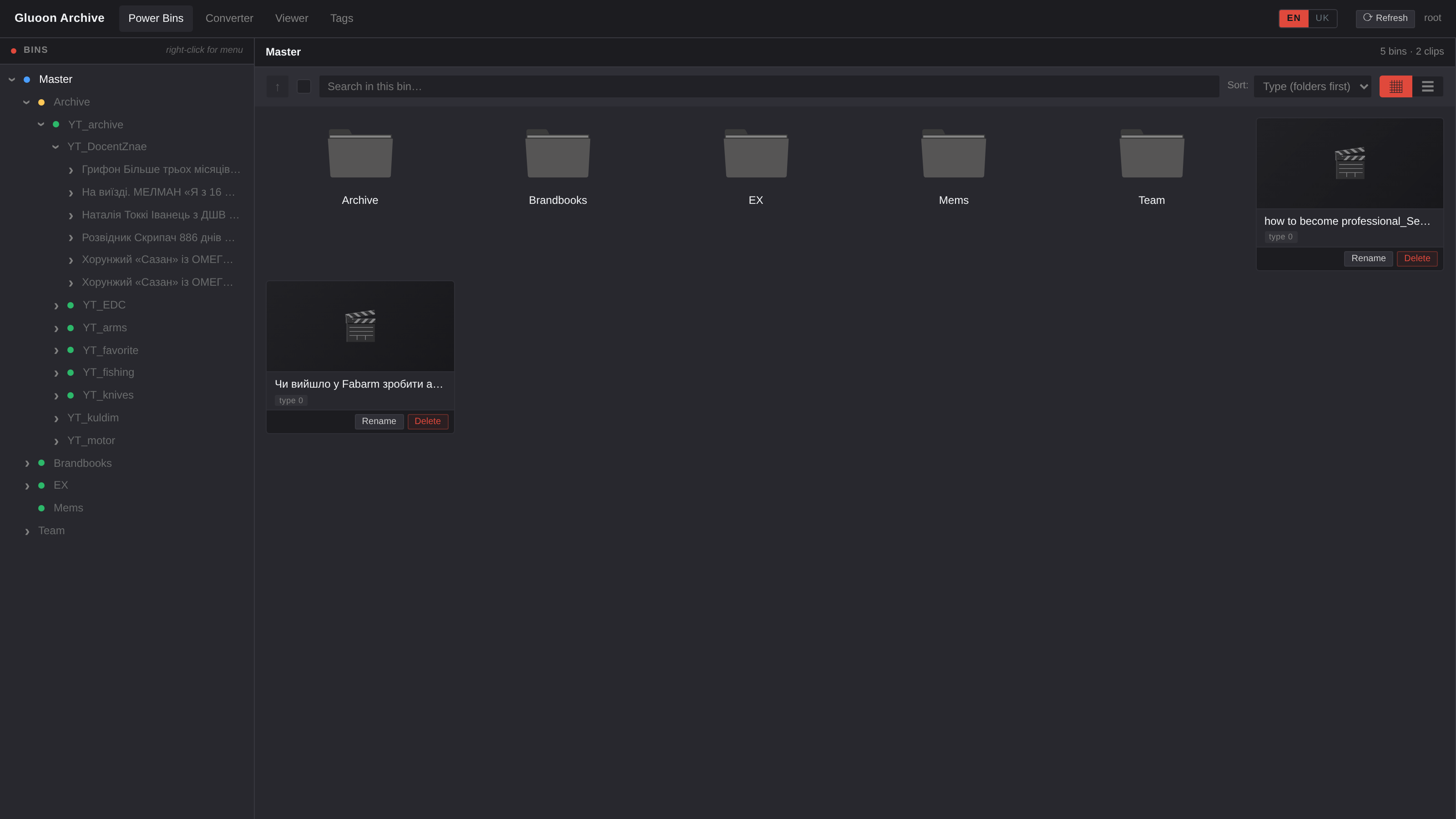
Gluoon Archive is a browser-based catalogue built directly on the Resolve project library. Search every clip you ever shot. Watch footage whose original is on a tape in a box. Send a trimmed subclip straight to a colorist's open timeline.
A project from three years ago opens. Half the timeline is red. The footage is somewhere โ an LTO tape, a shelf drive, a NAS that got reorganised, a folder called FINAL_v3_new. Nothing in Resolve can tell you where it went. Nothing in Resolve can tell you what was even in the shot.
Power Bins help inside one database, for one user. They are pointers to files: no state, no versions, no idea whether the file still exists. And every keyword, rating and note you added lives inside the project โ close it, and the knowledge goes with it.
"There is no way to search for clips or timelines across multiple projects. You can only search one project at a time."
Blackmagic Design user forum
So every facility solves it the same way: a spreadsheet, and one person who remembers. That person is the media asset manager, and they are a single point of failure.
Every asset manager on the market asks you to leave Resolve, import your media into their world, and manage it there. Gluoon Archive speaks Resolve's own database, natively, in both directions.
The app attaches to the Resolve project server's PostgreSQL and reads the pool, the folder tree, the bin colours and the clip names as they are right now โ not a mirrored copy that drifts out of date.
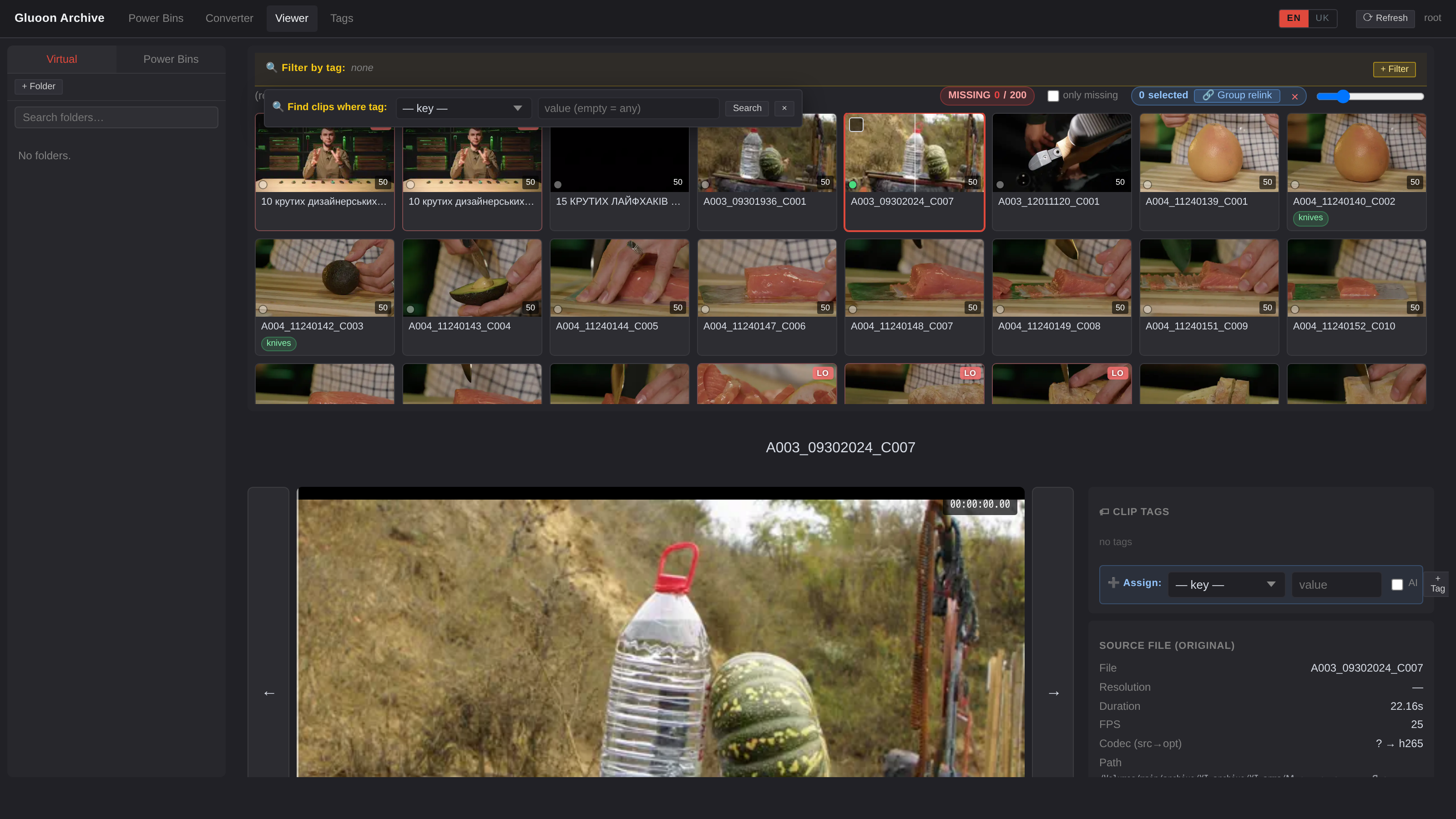
Every archived clip carries a 50-frame scrub strip, each frame stamped with its real timecode. Drag across the image and you are moving through the shot โ no media, no mount, no Resolve.
I and O, exactly as you would in an NLE
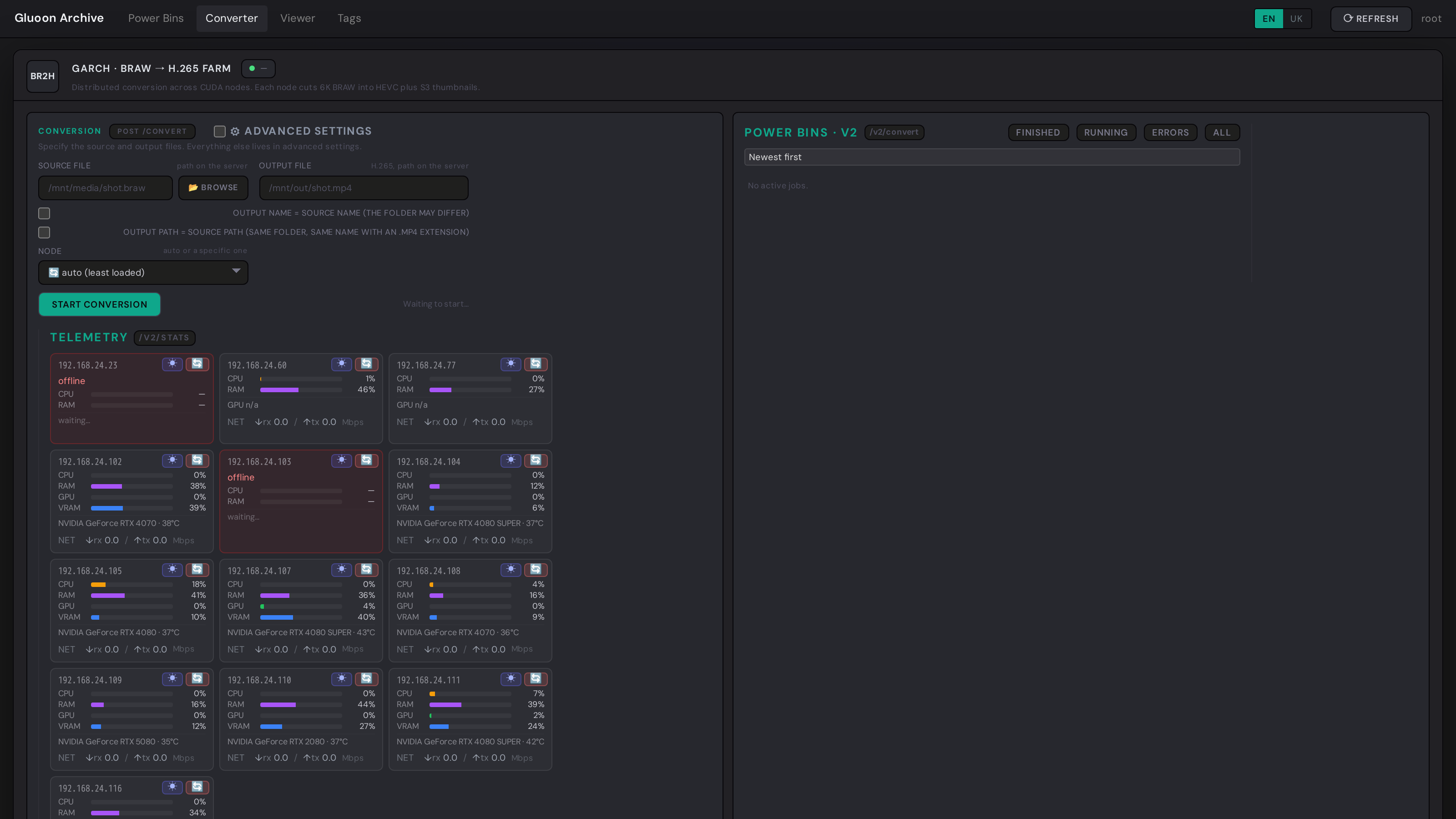
Thirteen editing machines โ Windows and macOS โ double as GPU transcode nodes. They cut 6K BRAW into H.265 proxies and scrub frames, two jobs each, dispatched to whoever is least busy.
A producer scrubs an archived clip in a browser tab, marks in and out, and hits Insert. The subclip appears in the Media Pool of the Resolve instance that is open right now, on the colorist's machine, at frame-accurate timecode.
Runs on the artist's workstation, auto-discovered over the LAN and authenticated with a shared secret. It reports whether Resolve is running, which version and which project is open โ so the browser shows a live status dot before you ever click.
Send the 6K BRAW if the drive is mounted, or the H.265 proxy if it isn't โ same in and out points either way. Drop it into a bin, or straight onto the open timeline. Or skip Resolve entirely and export an EDL.
hevc_nvencThis is why no third party has done this properly. Media paths, framerate, resolution and the user-visible clip name live inside opaque bytea blobs โ a serialised Qt stream. You cannot UPDATE a path with SQL. You have to understand the format.
// BtVideoInfo.Clip โ decoded, edited, re-encoded, byte-exact // round-trip verified on 2,000 / 2,000 production rows version 1 QDataStream, big-endian Path "Y:\2022\SPOT\A001_0612.braw" โ dead Path "/Volumes/main/2022/SPOT/A001_0612.braw" โ repaired FrameRate 23.976 a little-endian double inside a big-endian blob Resolution 6144 ร 3456 ClipFormat 8203 FOURCC 'BRAW'
We wrote a full decoder and encoder for that format. That is what makes bulk path repair โ pointing thousands of dead clips at their new home in a single pass โ actually possible.
And the library it points at โ the production Resolve project server this was built against โ is why the problem is worth solving at all:
Cloud storage. A web media browser. Review and approve. And now AI search across objects, faces and dialogue. Every piece is there โ and every piece stops at the edge of the open project.
"Search In: All Bins: Searches all bins in the project."
DaVinci Resolve 21 New Features Guide โ the IntelliSearch toolbar
The AI index lives inside the project. Start a new one and the same files must be analysed again. Meanwhile Archiware P5 โ the LTO backbone of post โ lists integrations with eleven asset managers. DaVinci Resolve is not among them, because there is nothing on the Resolve side to integrate with.
Three of Resolve's seven pages are companies you acquired and made free: Color, Fusion, Fairlight. This is the fourth.
| The question an archive has to answer | Power Bins | IntelliSearch | Gluoon Archive |
|---|---|---|---|
| Search every clip across all projects | no | project only | yes |
| Look at footage without opening Resolve | no | no | browser |
| Look at footage when the original is offline | no | no | yes |
| Keep metadata after the project closes | no | no | yes |
| Repair every broken media path in bulk | manual | no | one pass |
| Give a producer access without a Resolve seat | no | no | a URL |
A broken media path repaired across a whole folder in one pass. A browser scrub becoming a subclip on a real timeline. You will know inside ten minutes whether this is interesting.